



A strong foundation builds big dreams, Burj Khalifa
As the tallest building in the world (828 meters), its greatest challenge is not only to withstand the wind at the top, but also how to transfer a colossal load of 500,000 tons to the sandy soil and soft rocks (siltstone/sandstone) of Dubai. From a geotechnical and structural perspective, there is one main mechanism that is very crucial and exciting to discuss: the Friction Pile System & Raft Foundation.
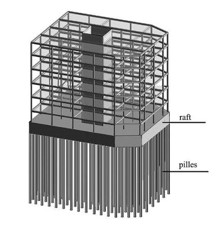
The most critical engineering challenge of the world’s tallest skyscraper is actually underground: how to support such a massive load on a geological layer that’s mostly sand and soft rock? A popular myth imagines that a building this tall is anchored all the way down to solid bedrock. In reality, Dubai’s geotechnical conditions don’t provide intact bedrock at shallow depths. What exists are layers of loose sandy soil, weak sedimentary rocks (weakly cemented siltstone and sandstone), and groundwater with very aggressive salt concentrations. To overcome these natural limitations, the geotechnical engineering team designed a combined Piled Raft Foundation system that utilizes the friction pile mechanism.
 |
How Friction Piles vs End-Bearing Piles Work
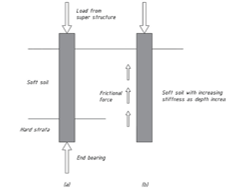
In conventional pile foundations (end-bearing pile), the building’s load is transferred directly through soft soil layers until the bottom of the pile rests on a hard rock layer. But when hard rock can’t be found at a reasonable depth, the load has to be supported through an alternative mechanism: pile skin friction. The working principle of a friction pile relies on the shear stress interaction between the outer surface of the concrete pile and the surrounding sedimentary rock. When a vertical load pushes the pile down, microscopic shifts at the concrete-soil interface trigger an upward frictional resistance. The foundation of the Burj Khalifa uses 192 bored piles, each 1.5 meters in diameter and reaching a depth of 50 meters below the ground. These piles don’t just stand alone; they’re tied together by a massive concrete raft 3.7 meters thick, poured continuously with high-performance concrete totaling 45,000 cubic meters.
 |
Piled Raft System & Preventing Differential Settlement
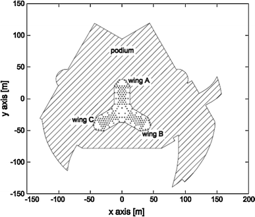
In a piled raft system, the concrete slab (raft) and the group of piles work together as a single integrated structural system. The concrete slab transfers some of the load directly to the surface soil, while the piles carry the largest portion of the load down to the deeper soil layers. The main challenge for a building with an asymmetric Y-shaped floor plan, like the Burj Khalifa, is the risk of uneven settlement. If one side of the building settles more than the other, the structure can experience secondary bending stresses that could trigger cracks or even dangerous tilting.
 |
Chemical Resistance: Fighting Dubai’s Aggressive Groundwater
Apart from load-bearing capacity issues, the next biggest threat to the Burj Khalifa’s foundation is the chemical condition of the local groundwater. Groundwater in Dubai’s coastal areas contains very high concentrations of chloride and sulfate—even much more concentrated and corrosive than regular seawater.
If chloride solutions seep through the concrete pores and reach the reinforcing steel (rebar), oxidation/corrosion will occur. Corrosion produces rust as a byproduct, which expands, creating internal tensile stress that cracks and destroys the concrete from within (spalling). Meanwhile, sulfate compounds can react with cement hydrates (calcium hydroxide) to form ettringite, which damages the concrete matrix.
In the end, the Burj Khalifa’s foundation proves that the tallest building in the world doesn’t always have to be built on solid rock. The key lies in the right combination of a piled raft foundation, utilizing pile skin friction, and protecting the concrete from groundwater corrosion. It’s this solid geotechnical understanding that allows this giant structure to stand firm and safe on desert soil.
References
Poulos, H. G., & Bunce, G. (2008). Foundation design for the Burj Dubai – the world’s tallest building. 6th International Conference on Case Histories in Geotechnical Engineering.
Poulos, H. G. (2009). Tall building foundation design: The Geotechnical Engineer’s Perspective. Geotechnical Engineering Journal of the SEAGS & AGSSEA, 40(1), 17-30.
Abdelrazaq, A. (2012). Validating the structural design and performance of Burj Khalifa. International Journal of High-Rise Buildings, 1(1), 37-51.
Baker, W. F., Korista, D. S., & Novak, L. C. (2007). Engineering the World’s Tallest Burj Dubai. CTBUH 8th World Congress, Dubai.
Russo, S., & Abagnale, V. (2011). Cathodic protection of reinforced concrete structures in aggressive soils. Materials and Corrosion, 62(2), 162-171.
Poulos, H. G. (2010). Geotechnical design for tall buildings. High-Rise Buildings: Design and Construction, CRC Press / Taylor & Francis.
https://link.springer.com/article/10.1007/s11440-012-0193-4
https://www.researchgate.net/figure/The-system-of-piled-raft-foundation-developed-by-authors_fig2_349316446
https://www.researchgate.net/figure/Load-transfer-mechanism-of-a-pile-foundation-a-end-bearing-pile-and-b-friction-pile_fig1_380353763
Comments :