



Taipei 101: A Modern Civil Engineering Masterpiece
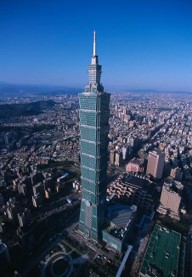
Taipei 101 stands as one of the most recognizable landmarks in Taiwan and represents a defining milestone in modern civil engineering. Located in the Xinyi District of Taipei, the skyscraper reaches a height of 508 meters (1,667 feet) across 101 stories above ground. Completed in 2004 after breaking ground in 1999, it held the title of the world’s tallest building until 2007, surpassing the Petronas Twin Towers. Designed by C.Y. Lee & Partners, the mixed-use tower integrates retail centres, corporate offices, and observatories, drawing aesthetic inspiration from a traditional pagoda and a segmented bamboo stalk
Standing at a height of 508 meters in the heart of Taiwan, Taipei 101 occupies one of the most hazardous civil engineering environments on Earth. Located along the active collision boundary between the Eurasian and Philippine Sea tectonic plates and directly exposed to the violent Western Pacific typhoon corridor, the skyscraper must endure both severe cyclic ground acceleration and extreme aerodynamic vortex-shedding forces. While conventional skyscrapers rely primarily on structural stiffness and perimeter bracing to resist lateral drift, ultra-tall structures also demand dynamic suppression systems to prevent severe peak accelerations that cause occupant motion sickness and structural fatigue. To resolve this challenge, structural engineers designed an iconic passive motion-control system: the 660-tonne Tuned Mass Damper (TMD).
From a civil engineering perspective, constructing Taipei 101 was a major challenge. The building had to withstand its own enormous weight as well as strong winds and earthquakes. Therefore, engineers had to develop structural and foundation systems that could provide both strength and flexibility.
According to Encyclopedia Britannica, Taipei 101 was designed as a mixed-use skyscraper containing offices, shops, restaurants, and observation areas. Its design consists of repeated eight-floor sections, giving the building its distinctive appearance. The number eight also has cultural significance in Chinese tradition and is commonly associated with prosperity and good fortune.
According to Encyclopaedia Britannica, Taipei 101 was designed as a mixed-use skyscraper containing offices, shops, restaurants, and observation areas. Its design consists of repeated eight-floor sections, giving the building its distinctive appearance. The number eight also has cultural significance in Chinese tradition and is commonly associated with prosperity and good fortune.
One of the most important engineering challenges was the foundation. A skyscraper as tall as Taipei 101 produces extremely large vertical loads that must be transferred safely into the ground. Engineers therefore designed a deep foundation system using large piles extending deep below the building. These piles transfer the structural loads through the soil and into stronger layers of ground, allowing the building to remain stable despite its enormous weight.
The main structural system of Taipei 101 combines a strong central core with perimeter columns and outrigger trusses. The core provides much of the building’s vertical and lateral strength, while the perimeter structure works together with the core to resist forces acting on the building. Outrigger trusses connect the core to the exterior columns at several levels. This system increases the overall stiffness of the building and helps reduce lateral movement caused by wind and earthquakes. The materials used in Taipei 101 are also an important part of its structural performance. High-strength concrete and steel are combined in major structural elements to provide the necessary strength and stiffness. Some of the building’s large columns use steel box sections filled with high-strength concrete. This composite construction allows the columns to carry very large loads while maintaining the structural efficiency required for a supertall building.
Wind resistance is one of the biggest challenges in designing a skyscraper. As a building becomes taller, wind forces become increasingly important, and excessive movement can cause discomfort for occupants. Taipei 101 addresses this problem with a Tuned Mass Damper (TMD), a large steel sphere installed near the upper floors of the building. The damper weighs approximately 660 metric tons and is designed to move in response to the movement of the building. Its motion helps counteract some of the building’s movement and reduces excessive swaying.
Earthquake resistance is another essential feature of Taipei 101. Because Taiwan is in a seismically active region, the building needs to withstand significant horizontal forces during an earthquake. Its strong central core, perimeter frames, outrigger system, and foundation work together to provide stability. Instead of attempting to make the building completely rigid, engineers designed the structure to have controlled flexibility, allowing it to absorb and redistribute forces safely.
The architectural form of Taipei 101 also contributes to its engineering performance. The building consists of several stacked sections that gradually rise toward the sky. Besides creating its iconic appearance, this configuration helps break up the effects of wind along the height of the building. The combination of architectural design and structural engineering demonstrates how aesthetics and functionality can work together in a modern skyscraper.
Taipei 101 is therefore much more than a landmark or tourist attraction. It represents the integration of structural engineering, geotechnical engineering, materials engineering, and architectural design. Every major component, from its deep foundation and high-strength structural elements to its outrigger system and Tuned Mass Damper, has an important role in maintaining the building’s safety and stability.
References
Klemencic, R., & Taylor, P. R. (2006). Structural Design of Taipei 101: Challenges and Solutions for Wind and Seismic Loads. International Journal of High-Rise Buildings / CTBUH Technical Papers.
https://eng.taiwan.net.tw/m1.aspx?sNo=0002090%20&id=3469
https://www.atlasobscura.com/places/tuned-mass-damper-of-taipei-101
https://www.britannica.com/place/Taipei-101
https://www.structuremag.org/article/dynamic-loading-solutions-in-taipei-101/
Comments :