



How Indonesia’s “Chicken Claw” Foundation Conquered Swampy Grounds at Soekarno-Hatta Airport
 |
Imagine landing a modern commercial airliner, such as a Boeing 777 or Airbus A350, weighing up to 350 metric tons at full load onto a spongy, waterlogged swamp. Every square meter of the pavement receives tremendous static and dynamic stresses during taxiing and parking. In conventional geotechnical practice, constructing heavy load-bearing infrastructure on soft alluvial clay or swampy soil poses severe risks, such as catastrophic differential settlement, subgrade shear failure, and severe pavement cracking.
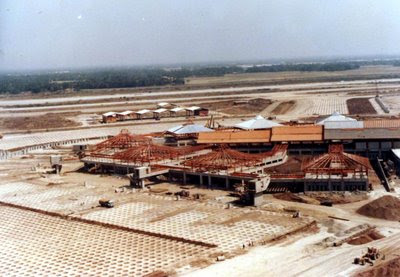
When Indonesia initiated the construction of Soekarno-Hatta International Airport (CGK) in Cengkareng during the early 1980s, engineers faced exactly this predicament. The soil profile revealed deep layers of soft, highly compressible clay with high water content. Standard solutions, such as deep pile foundations under entire tarmac slabs or complete soil excavation and replacement, were either astronomically expensive or required years of pre-consolidation time.
Despite being called “Pondasi Cakar Ayam” (Chicken Claw Foundation), the structure uses no animal parts. The name was inspired by the visual appearance of thin vertical concrete pipes pointing downward into soft soil, resembling the splayed claws of a chicken gripping the earth. The genius solution did not originate in a high-tech airport lab, but during a municipal crisis in 1961. The inventor, Prof. Dr. Ir. Sedijatmo, then an engineer at Indonesia’s state electricity company (PLN), was tasked with erecting five high-voltage electricity towers in the swampy marshlands of Ancol, North Jakarta. Due to tight deadlines and challenging terrain, traditional deep foundations could not be installed in time for two of the towers. Prof. Sedijatmo devised an unorthodox mechanism. A thin concrete slab stiffened by hollow thin-walled concrete pipes submerged vertically into the soft earth. The result was astonishing that the towers stood perfectly rigid without sinking or tilting.
The structural brilliance of the Chicken Claw Foundation lies in its mechanics. Conventional engineering attempts to transfer loads directly down to hard bedrock via long deep piles. The Cakar Ayam system takes the opposite philosophical approach, which utilizes the soft soil itself to create stability. When a heavy aircraft rests on the concrete slab, the downward force pushes the slab into the subgrade. This downward movement forces the soft soil into the hollow space inside the vertical pipes. As soil fills and compresses within the pipe walls, passive earth pressure increases rapidly. The soil trapped inside the pipes gets confined and acts as a rigid soil plug. Instead of bending or cracking, the flexible thin slab gains extreme rigidity through the stiffening effect (stiffener effect) provided by these soil-filled pipes. The heavy concentrated wheel loads are instantaneously redistributed over a vastly larger surface area.
At Soekarno-Hatta Airport, the Cakar Ayam system was deployed extensively across the apron areas, taxiways, and access roads. The apron is where aircraft sit stationary for hours, subjecting the pavement to immense continuous static load, often far more demanding on subgrades than short dynamic landings. By employing Cakar Ayam, the Indonesian Ministry of Public Works and airport authorities eliminated the need for deep subgrade replacement. Decades after its construction, the apron remains remarkably level and resilient, handling millions of aircraft movements and facilitating international air travel smoothly.
Prof. Sedijatmo’s patented system also gained worldwide recognition. International patents were awarded across multiple countries, including the United States, United Kingdom, Germany, France, Canada, and Netherlands. It stands as one of Indonesia’s most prominent gifts to global structural and geotechnical engineering.
References
Brilian, A. P. (2024, 8 Maret). Siapa Penemu Fondasi Cakar Ayam? Ini Orangnya. DetikProperti. https://www.detik.com/properti/berita/d-7231635/siapa-penemu-fondasi-cakar-ayam-ini-orangnya
Efendi, A. W., & Safitri, N. (2023). Behavior of Cakar Ayam Modifikasi (CAM) foundation on soft soil with LISA V.8 FEA. Kurva S: Jurnal Keilmuan dan Aplikasi Teknik Sipil, 11(1), 29–43.
Fikriansyah, I. (2026, 26 Mei). Tak Banyak yang Tahu, Cikal Bakal Fondasi Cakar Ayam Berawal dari Ancol. DetikProperti. https://www.detik.com/properti/berita/d-8504936/tak-banyak-yang-tahu-cikal-bakal-fondasi-cakar-ayam-berawal-dari-ancol
Idris, M. (2026, 5 Januari). Mengenal Pondasi Cakar Ayam, Teknik Konstruksi Lokal yang Mendunia. Kompas Properti. https://www.kompas.com/properti/read/2026/01/05/230600221/mengenal-pondasi-cakar-ayam-teknik-konstruksi-lokal-yang-mendunia Rahman, T. et al. (2015). Evaluation of Bearing Capacity and PCN of North Runway Cakar Ayam System in Soekarno-Hatta International Airport Using Finite Element Modelling (Case Study: To Operate the B777-300ER Aircraft). Conference: The 18th FSTPT International Symposium, Unila, Bandar Lampung.
Comments :